What is it and why is it important to detect it on time?
Macular degeneration, or more commonly referred to as age-related macular degeneration, affects a part of the retina called the macula (or yellow spot). This is a small but very important area in the center of the eye that provides clear and central vision—necessary for reading, recognizing faces, and all activities that require focus.
Over time, often after the age of 50, the macula can begin to deteriorate. This condition does not cause complete blindness but affects central vision—making reading, driving, and even watching TV challenging. Peripheral vision remains intact, allowing a person to move independently, but the loss of sharpness in the center is very limiting.What are the risk factors?
- Age (especially over 50 years)
- Heredity (if someone in the family has had it)
- Smoking
- High blood pressure and cholesterol
Dry and wet form—what is the difference?
1. Dry macular degenerationThis is the more common and slower-progressing form. In this condition, the cells in the macula begin to weaken and die over time. Sometimes, in more advanced stages, areas of the retina may simply be absent—this is called geographic atrophy.
There is currently no treatment to reverse the process, but supplements (containing lutein, zeaxanthin, omega-3, and antioxidants) can slow the progression of the disease.2. Wet macular degenerationThis is a rarer but more aggressive form. In this condition, new, unstable blood vessels begin to grow under the macula. These can bleed or leak fluid, leading to rapid worsening of vision.
If not treated in time, scars may form, which permanently damage the macula.
What are the symptoms?
- Blurred or distorted central vision
- Difficulty reading or recognizing faces
- Dark spot or shadow in the center of the visual field
- Distorted lines—for example, straight lines in a crossword appear wavy
- Delayed adjustment to darkness
- Problem with color perception
How is the diagnosis made?
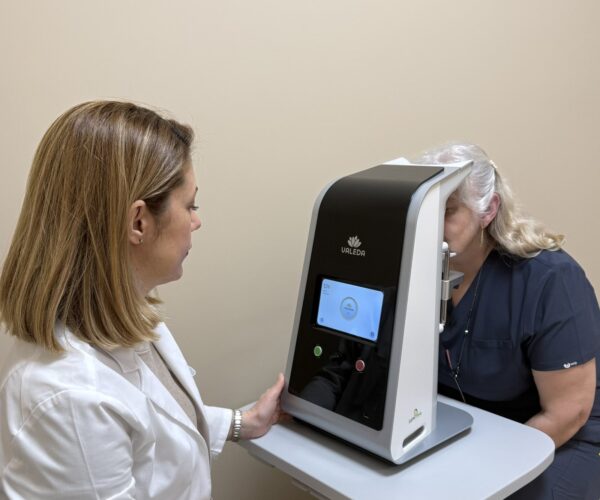
During a routine eye examination with pupil dilation, the ophthalmologist can see early changes in the macula. For more accurate diagnosis, an OCT scanner is used (a very precise device for retinal imaging). Sometimes, fluorescein angiography is also performed to observe the retinal blood vessels.
How is the wet form treated?
The good news is that wet macular degeneration is successfully treated with injections that stop the growth of these ‘bad’ blood vessels and reduce leakage and bleeding.
This treatment is called anti-VEGF therapy. The medication is administered directly into the eye, but don’t worry — the procedure is under local anesthesia and is painless. The entire visit takes about 15 minutes, after which you go home.
The treatment is repeated regularly (usually once a month) for several months or even years. There are various medications available — Eylea, Vabysmo, Beovu, etc. — and at Pentagram Clinic, we use all approved medications.
Why is early detection important?
The earlier we detect the condition, the greater the chance of preserving vision. The wet form can develop quickly, and sometimes people themselves don’t immediately notice changes. That’s why regular preventive examinations are extremely important, especially after the age of 50.
Why choose Pentagram Eye Clinic?
At Pentagram Clinic, we have been treating macular degeneration since 2012. We work with all available medications globally and have the most advanced OCT scanner, which detects even the smallest changes.
We create an individual plan for each patient and perform injections on an outpatient basis — quickly, safely, and painlessly. We have participated in international clinical studies and are certified by leading regulatory bodies in the USA and Europe.
Synonyms: AMD, Retinal Wear, Central Vision Loss, Age-related Macular Degeneration